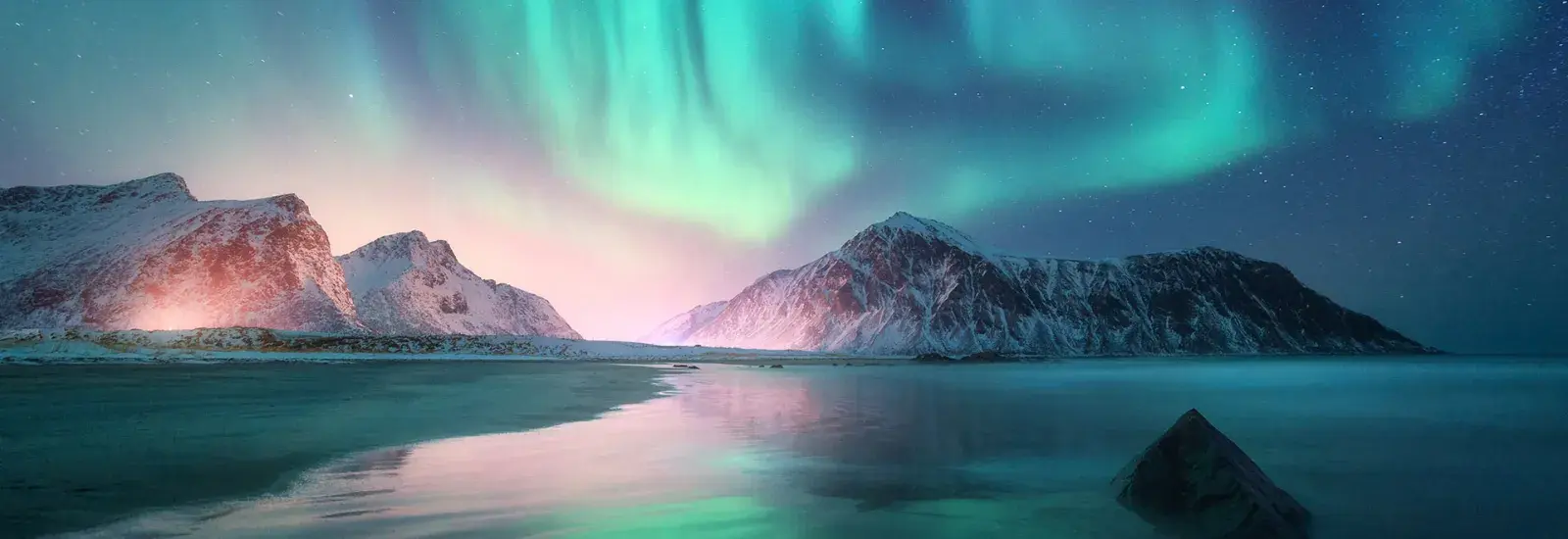
Arctic Travel Information
Arctic travel information is essential for anyone preparing to explore the remote polar regions of the Arctic. This guide brings together key details on how to get to the Arctic, the best time to travel, visa and entry requirements, health and safety considerations, packing advice, onboard life, and insights into major destinations such as Svalbard, Greenland, the Canadian Arctic and the North Pole. Whether you're joining an expedition cruise, wildlife spotting polar bears and walrus, or learning what to expect from Arctic weather and ice conditions, this resource provides clear, practical information to help you plan a safe and unforgettable journey to the top of the world.
What locations make up the Arctic?
How do you get to the Arctic?
When is the best time to go?
Travel advice and safety precautions
Passports & visas
Insurance
Taxes & charges
Money in the Arctic
Health Information
Life onboard an expedition ship
What to pack
What locations make up the Arctic?
Canadian Arctic
Beyond Canada’s continental north you will find the Canadian Arctic Archipelago, with over 36,000 islands, most lying deep within the Arctic Circle. A cruise in this remote region takes you through incredible wilderness scenery of fjords, glaciers, mountains and pack ice. The Canadian Arctic is also well known for its diverse wildlife, history and rich Inuit culture. It is home to seals, whales, polar bears, caribou, musk oxen, walruses, Arctic wolves and foxes as well as thousands of seabirds that nest in the cliffs. Here you may also encounter small indigenous communities and the archaeological remains of hunting lodges that date back thousands of years. It is in this region that you can follow in the wake of the legendary explorers Amundsen, Baffin and Franklin who searched for the Northwest Passage, a fabled trade route across the Arctic from Europe to the Far East. The two ships under Franklin’s command disappeared mysteriously before Amundsen made the first successful navigation of the route on his 1903-6 Gjoa expedition.
View our range of Canadian Arctic Itineraries
Greenland
Unique, spectacular and dramatically beautiful, Greenland is dominated by a vast ice cap that covers 80% of the island. It is the largest non-continental island in the world, lying almost entirely within the Arctic Circle. Greenland’s waters are strewn with icebergs, sometimes turquoise and sometimes beautifully sculpted. Glaciers are prolific and the coast is lined with fjords. For wildlife enthusiasts, Greenland will not disappoint as it is home to polar bears, musk oxen, reindeer, walruses, whales, seals and sea eagles. And then of course there are the incredible Northern Lights (Aurora Borealis), Greenland providing one of the best vantage points to see the spectacular display of colours flashing across the Arctic sky.
View our range of Greenland itineraries
Spitsbergen (Svalbard)
The only permanently inhabited island in Svalbard and renowned for being home to more polar bears than people, Spitsbergen is an unrivalled Arctic destination. In summer, you can cruise the Arctic waters and tackle heart-thumping expeditions by dog sled. In winter, be blown away by the spectacle of the Northern Lights. Spitsbergen is the most visited Arctic destination in Europe and a brilliant introduction to Arctic explorations.
View our range of Svalbard itineraries.
Iceland
Iceland is one of the most dramatic and geologically active destinations in the North Atlantic, making it a popular starting or ending point for expedition cruises to Greenland. Ships circumnavigating the island or visiting selected ports encounter a landscape shaped by fire, ice, and ocean, with wildlife and culture woven into every stop.
Related blogs:
- Best places to visit in the Arctic
- Arctic Landscapes - What to expect
- Iceland vs Greenland
- Meet the people of Longyearbyen
- Arctic Animals - Meet the wildlife of the north
- Insight guide to Arctic Expeditions
How do you get to the Arctic?
Canadian Arctic
The easiest and most popular way for Australians to get to Ottawa is via Vancouver or Los Angeles.
Iceland
There are direct flights to Reykjavik from London as well as other European capitals.
Greenland
Cruises will usually start or end in Kangerlussuaq, Nuuk, Longyearbyen or Reykjavik. Charter flights are often used as part of your Arctic cruise package, so your Destination Specialist can advise you on the best flight options at the time of booking.
Svalbard
You will fly via Oslo or Tromso to Longyearbyen. There are a variety of major airlines flying from Australia to major hubs in Europe.
Related blogs:
When is the best time to go?
The Arctic Season runs from May to September.
Early Season (May – June)
In May and early June, the region begins to awaken after winter, with snowy landscapes, dramatic ice, and excellent chances of seeing polar bears on the sea ice, all with fewer travellers and a more expedition style feel.
Mid Season (June - July)
By late June and July, the Arctic is alive with wildlife under the Midnight Sun, with bustling bird cliffs, returning whales, and tundra flowers in bloom — an ideal time for exploring Svalbard, Greenland, and the Canadian Arctic.
Late season (August-September)
August and early September provide the warmest water temperatures and the best whale‑watching of the season, along with minimal sea ice that allows ships to venture deeper into remote regions such as the Northwest Passage. By September, autumn colours sweep across the tundra and the return of darker nights offers the first chances to see the Northern Lights, while wildlife remains active before winter sets in.
Related blogs:
Travel advice and safety precautions
Australian citizens
We recommend registering with Smartraveller to be kept up to date with the latest travel advice and safety precautions: https://www.smartraveller.gov.au/
New Zealand citizens
We recommend registering with Safe Travel be kept up to date with the latest travel advice and safety precautions:
https://www.safetravel.govt.nz/
UK citizens
we recommend checking the FCO website for the latest travel advice and safety precautions:
https://www.gov.uk/foreign-travel-advice
United States Citizens
We recommend enrolling in STEP (Smart Traveler Enrollment Program) to be kept up to date with the latest travel advice and safety precautions:
https://travel.state.gov/en/international-travel/travel-advisories.html
Canadian citizens
We recommend registering with Canadians Abroad. A free service that allows the Government of Canada to notify you in case of an emergency at your destination or a personal emergency at home.
https://travel.gc.ca/travelling/registration
Passports & Visas
Passport validity
Please ensure that your passport is valid for at least six months after the return date of your holiday, and you have sufficient blank pages for any entry/exit stamps.
ESTA for transiting through the United States
Most passport holders must obtain an approved Electronic System for Travel Authorization (ESTA) to transit through the United States https://esta.cbp.dhs.gov/esta
Travel insurance
Travel insurance is one of the most important parts of any trip, especially when you’re travelling to the Arctic — a remote, rugged, and often unpredictable region. It’s essential to have comprehensive cover for:
- Accidents & Emergency Evacuation
Because Arctic destinations are extremely remote, medical assistance, evacuations, and repatriation can be incredibly costly. Many expedition operators require a minimum level of emergency evacuation cover, so always check the specific requirements with your booking agent. - Sickness & Loss of Luggage
If you have pre existing medical conditions, you must declare them, and be aware that some conditions may not be covered. Read your policy wording carefully to understand what is and isn’t included. - Cancellation / Travel Disruption
Take out your policy at the time of booking to ensure you’re protected if unforeseen circumstances prevent you from travelling. Insurance should also cover disruptions or changes to your itinerary due to local conditions — something that can happen in the Arctic. - Weather Related Delays
Weather in the Arctic can be unpredictable, and delays are not uncommon. Make sure your policy includes cover for travel interruptions caused by severe weather or sea ice conditions. - Specific Destinations / Cruise Cover
Choose a policy that covers all the regions you’ll be visiting, such as Svalbard, Greenland, Iceland, Arctic Canada, or the North Pole. Some policies require you to add “cruise cover” to be protected while onboard an expedition vessel. If in doubt, confirm with your insurance provider. - Activities
Ensure your policy covers any optional activities you plan to join, such as kayaking, hiking, camping, snowshoeing, or polar plunges. Some adventure activities require additional cover.
Taxes & Charges
Baggage Allowances
Please check with your airlines ahead of time and/or when booking flights to determine what your carry-on and checked bag allowance is as this often varies. Excess baggage fees can be very expensive.
Domestic flights often have stricter baggage restrictions and some carriers do not include baggage allowance on their domestic routes and will charge upon check in.
Charter flights also have very strict luggage restrictions, please refer to your documentation if relevant to your booking.
Always carry your important documents and necessities (including any prescribed medication) in your carry-on luggage.
Fuel Surcharges
Please note that should world oil prices increase significantly prior to departure your cruise booking may be subject to fuel surcharges. Cruise operators do attempt to factor this into the price of your cruise. However, unexpected rises in the cost of marine fuel can change rapidly and sometimes it is necessary for these to be passed on. By booking a tour with us, you accept this as part of our booking terms. Once we have been notified of any surcharges from the cruise operator, we will endeavour to advise you as soon as possible.
Changes to schedule
The Arctic is an extreme environment. While all efforts will be made to keep to the planned schedule, there may be reasons outside of the cruise company’s control that will result in changes to your planned program. If the itinerary is changed to allow for weather (or other factors) then you agree that this is the nature of expedition cruising and that no compensation will be offered because of applicable itinerary changes.
Deposit & Final Payment
Please refer to your invoice for details of deposit and final payment. All deposits are non-refundable as per our terms and conditions. It is important to remember that failure to pay deposits or to make the final payment by the due date may result in the cancellation of your booking.
Money in the Arctic
The currency that you’ll use during your Arctic voyage will depend on the countries you are visiting during your trip.
Norway
If you are joining in Longyearbyen, the local currency is the “Norwegian Krone” and is represented as NOK, although many shops in Longyearbyen accept Euros.
Iceland
For tours that visit Reykjavik in Iceland, the local currency is the “Icelandic Krona” and is represented as ISK.
Canada
In Iqaluit, the local currency is the “Canadian Dollar” and is represented as CAD.
Greenland
In Kangerlussuaq the local currency is the “Danish Krone”, represented as DKK.
Most cruise ships accept Euros € and US $ to settle any onboard expenses. Major credit cards, in particular Visa and Mastercard are also widely accepted on board. In general, all on board purchases made during the cruise are charged to your cabin and settled at the end of the voyage.
Tipping Guidelines
Crew members are paid a fair wage. Tipping staff is still recommended for good service. You can choose what you deem fair and think about what you would pay in your home country.
A suggested amount would be US$15 per day.
Without the crew, and their expertise, the voyage would not be possible. On most cruise ships, tips are collected centrally and distributed amongst the entire crew.
Health Information
Most Arctic cruise ships have an infirmary and a qualified physician onboard to provide routine and emergency health care. There is usually a charge for a consultation and for any medication prescribed, although seasickness is often treated free of charge.
Medication brought from home
It is recommended to pack double the amount you might require.
Seasickness
Motion sickness is very common, particularly when crossing the Drake Passage, which is often rough. There are a variety of over the counter and prescription remedies available. Inter-dermal patches (such as Scopolamine patches) and bands tend to be the most effective preventative medication.
Seasickness medication is most effective if taken prior to the onset of nausea - so don’t wait until you feel sick to start taking it. If you are prone to motion sickness, it is best to stay hydrated, eat small amounts regularly and avoid alcohol, tobacco, excess liquids and confined spaces.
Back to top
Life onboard an expedition ship
Expedition ships are much smaller than large contemporary cruise ships with more limited facilities. The majority have a lecture theater, lounge, library and a bar and restaurant. Some ships may have a gym, spa, sauna or small pool. Ships are generally not equipped with stabilizers (this helps them to land close to shore) and hence can move significantly in areas such as the Drake Passage crossing. A doctor is on board, in case of major sickness, but passengers should be prepared.
Daily Program
The expedition leader will advise the program for the following day in the evenings. They will outline mealtimes, activities, events, excursion times and details of any lectures or presentations. There may be changes to the scheduled daily program due to weather, sea and ice conditions or to take advantage of opportunities such as wildlife sightings.
Dress on board
We recommend you wear casual and informal clothes onboard that are lightweight and easy to care for. Warm clothing is needed when on deck. You should opt for things you can layer in a hurry if there’s a wildlife sighting. Some ships require slightly dressier attire, such as a sports jacket and collared shirt for men, and equivalent for women, for the captain’s dinner.
Food & Dining
Most Arctic vessels have dining rooms that can seat all guests in one sitting. The menus feature a diverse selection of dishes prepared by chefs. Breakfasts and lunches tend to be buffet style, while dinner is usually a three or four-course meal. Vegetarian options are available but please advise us of any special dietary requirements at time of booking or note these on your Passenger Information Form. Some dietary requirements may be more difficult to cater to. If you do not advise dietary requirements in advance, it may not be possible to cater to them.
Internet
You can stay connected to the internet on board most ships. Connections can be slow and most ships charge you based on the amount of data you use. Mobile phones and roaming do not work in most areas. Please refer to your pre-departure information for more information about what your ship offers.
Laundry
Most ships provide a laundry service. You will be charged per item. Some ships have a heated mudroom where wet clothes can be stored and dried.
Electrical Outlets
The electrical outlets on board many vessels are 220V (AC current) with European 2 pin round holes, as well as 110-volt shaving sockets in bathrooms for electric razors. Please check your pre-departure information and consider bringing an international adapter and you may need to bring a voltage converter.
Smoking
Smoking is only allowed in designated areas on the outside decks. Smoking is not permitted anywhere inside the vessel, in cabins or anywhere near the Zodiacs and is strictly prohibited when making onshore landings. Please remember to respect the natural environment and dispose of all cigarette butts in designated ashtrays or bins. DO NOT under any circumstance throw any cigarette butts overboard.
Zodiac Cruising
You will be transferred from the ship on excursions by Zodiacs. These are large, stable vessels that are extremely safe and designed for expeditions. They are used for Zodiac cruises among icebergs and alongside wildlife such as whales. Most zodiacs carry between 10 and 15 people. Your ship will provide a briefing, including information on the best and safest way to board and exit a Zodiac and the difference between wet and dry landings. They will have specific rules and regulations but the following acts as a general guide.
- Keep your hands free of personal items so you can hold on and accept assistance when embarking or disembarking the Zodiac.
- Bring waterproof bags or dry sacks to store electronics and valuables.
- While the Zodiac is in motion, you must remain seated with your feet on the deck. Never attempt to stand unless the Zodiac driver has given permission to do so. On arrival at a landing site or alongside the ship gangway, remain seated until instructed to disembark.
- Keep your body, arms and hands inside the Zodiac to avoid injuries.
- Boots and clothing must be cleaned before and after each landing to avoid contamination of landing sites.
Related blogs:
What to pack
The Arctic is an extreme environment, and the weather can change dramatically with no warning. UV radiation is strong and you should bring plenty of sun protection. Temperatures vary from -20°C (-4°F) to + 5°C (41°F). For your comfort avoid getting wet and bring wind and waterproof outer layers. Wool, silk and some of the new synthetic fibers like polar fleece retain heat better than cotton.
Body heat is easily lost from the hands and feet and the head, so keep them warm and dry. For hands, mittens are better than gloves and wear a hat or beanie. Between each layer there is a film of trapped air which, when heated by your body, acts as an excellent insulator. It also gives you the flexibility to remove a layer if you are too warm to keep you from overheating.
We recommend that you pack your gear in sturdy soft-sided luggage to make it easier to stow in your cabin. Try to avoid overpacking and bring informal, practical attire for your trip that can be worn in layers.
Clothing guide for excursions
- Thermal underwear
- T-shirt
- Down inner jacket
- Fleece (for extra cold days)
- Waterproof outer jacket (usually provided)
- Waterproof trousers (essential – you cannot ride on zodiacs without these)
- Thermal socks
- Waterproof gloves (and glove liners)
- Boots (supplied by ship)
- Scarf/Snood
- Sunglasses
Clothing for the ship
- Underwear & socks
- Pyjamas
- Gym clothing
- Toiletries & medication
- T-shirts
- Jumpers
- Nice shirt for casual dinners
- Swimsuit (hot tubs & polar plunge!)
- Jeans/trousers
- Enclosed shoes
Related blogs:
We use cookies on this site to enhance your user experience Privacy policy
Got It